Archived News - Housing
Central Bedfordshire Council Local Plan Consultation
 Consultation on the local plan began at 10am on Thursday 11th January 2018 for a period of six weeks until 5pm on Thursday 22nd February 2018.
In accordance with Regulation 19 of The Town and Country Planning (Local Planning) (England) Act 2012, CBC is publishing its Pre-submission Local Plan and are inviting you to express your views by taking part in the consultation.
All of the documents are available to view from 10am on Thursday 11th January on-line and at the Council Offices in Chicksands (opening times from 8:30 to 17:00 Mon -Thurs and 8:30 - 16:00 on Friday). In addition, the Local Plan will be available to view at the Customer Service Centres in Biggleswade and Leighton Buzzard, and the main libraries across Central Bedfordshire (opening times vary).
It is important you have your say now because only the comments (representations) submitted during this consultation will go forward to the independent Planning Inspector to review before the Public Examination on the Local Plan. In addition, only those who have made a comment can speak at the Public Examination sessions.
During the consultation, you'll be able to submit feedback online by the following centralbedfordshire.gov.uk/planning/policy/local-plan/overview.aspx
or in writing to CBC at: Local Plan, Central Bedfordshire Council, Priory House, Monks Walk, Chicksands, Shefford, SG17 5TQ
300 More Houses in Eaton Bray
Central Beds Council will publish the draft version of their Local Plan in December 2016.. This will set out the additional development, in 3 categories (residential, employment and traveller sites), that they are looking to implement by 2030.
Landowners in Eaton Bray have submitted a greater acreage of sites than all the other villages in the near vicinity combined. Eaton Bray Parish Council have been advised by CBC that they expect 150-300 more houses to be built in Eaton Bray.
Given that there are currently just under 1200 dwellings in the village, 300 more would be an increase of 25%. All the proposed sites lie in the area from Bower Lane to The Rye inclusive. Residents need to consider the impact on:
- Roads and traffic
- Foul and surface water drainage
- Capacity for additional electricity and gas supply, water supply, telephone and broadband connections
- School places and GP services
- The consequent effect of all the above on property values
Anyone who objects to these proposals should:
- Lobby their CBC Ward Councillor, Ken Janes (01582-601317)
- Lobby EB Parish Council
- Attend a CBC meeting on 26 January 2017 2.30 to 7.30pm, venue to be advised
| ID | Site Address | Site Size (hectares) |
|---|---|---|
| ALP072 | Land to the rear of Great Green Farm, The Rye, Eaton Bray | 5.7079 |
| ALP103 | Land to the rear of Bower Lane, Eaton Bray | 8.0744 |
| ALP192 | Land adjacent to 25-57 Bower Lane, Eaton Bray | 0.573 |
| ALP423 | Land east of Northall Road, Eaton Bray | 15.8583 |
| ALP464 | Westrope Brothers, 17 The Rye, Eaton Bray | 1.0251 |
| ALP478 | Doolittle Meadow Farm, Harling Road, Eaton Bray | 8.3729 |
| NLP013 | Park Lane, Eaton Bray | 1.4189 |
| NLP204 | Land at Northall Rd, Eaton Bray LU6 2BQ | 20.29 |
| NLP250 | Bower Lane, /Dunstable Road Eaton Bray LU6 1RB | 2.15 |
| NLP300 | Land south of Bower Lane, Eaton Bray LU6 1RB | 9.8302 |
| NLP316 | Land adjacent to The Meads, Eaton Bray LU6 2DS | 12.1926 |
| NLP483 | Land off Eaton Park, Eaton Bray | 2.691 |
Have your say on changes to housing allocations policy in Central Bedfordshire
 Central Bedfordshire Council is reviewing its Allocations Policy for social and affordable rented housing. Allocations Policy governs who can apply to join the housing register for a council or Housing Association home, what type and size of property they can apply for, and what priority applicants have in relation to each other.
The proposed changes stem from new freedoms in the Localism Act 2011, allowing councils to reflect local priorities in the way that they manage housing allocations.
The key aims of the scheme are to-:
- help applicants in housing need to find suitable housing
- provide housing applicants with a simpler, fairer and more transparent system
- encourage applicants who are out of work to seek employment
- make efficient and best use of the area's housing stock
- to encourage applicants to think longer term about their housing plans.
The proposed changes will affect existing and prospective applicants to the housing register.
Formal public consultation on these changes has begun, and will remain open until 31 January 2014. You can read all of the associated documents and give feedback online at www.centralbedfordshire.gov.uk/consultations
Paper copies of the consultation documents are available at the Council's offices at Watling Housing in Dunstable; or alternatively can be obtained by contacting the Partnerships and Engagement Team, on 0300 300 4237.
Developer bucks national trend with new housing scheme
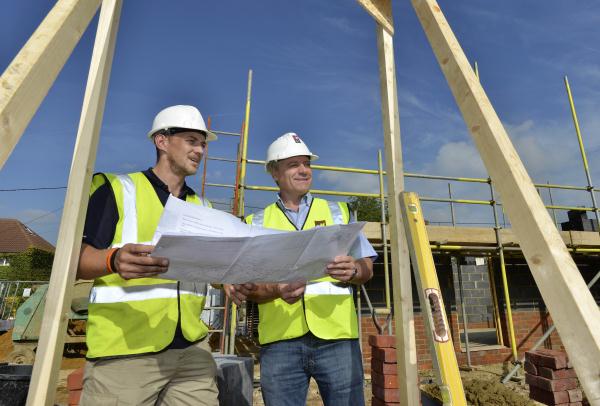 An award-winning developer which has bucked the national trend by having a waiting list for its homes has started work on its latest housing scheme.
Taylor French Developments, based in Tring, has created 60 jobs by beginning building work on a new site in Eaton Bray.
Although work has only just started, two of the homes have already been sold and there has been massive interest in the other two. They will be completed ready for families to move in by the end of March next year.
Taylor French is keen to play its part in local community life while building work takes place, sponsoring a magic act which entertained the crowds at St Mary's Village Carnival in nearby Edlesborough in July.
The Castle Gate development, in Eaton Bray, comprises two three-bedroom semi-detached houses, one three-bedroom detached house and one four-bedroom detached house, with prices ranging from £285,000 to £375,000.
Key to Taylor French's success is its bespoke building and design service where buyers can make significant changes to the specification, depending on how far building work has progressed.
Buyers have had en suites removed or added, internal walls changed, one had an extension added (subject to planning approval), while another asked for the whole of the back of the house to be glass panelled.
Steve French, Managing Director of Taylor French, said: "Buyers can get a bespoke home. It's not just giving them a few choices for kitchen units and bathroom tiles – it really does mean they can have the home they want, to the budget they choose.
"So, in a development of five houses, it is highly unlikely that they will all be the same."
Taylor French has buyers queuing up to buy its homes and has seen its turnover double each year since 2008.
Steve said: "The last two developments we've done all sold prior to formal marketing. I don't know of any other developer who has done this in the current climate.
"We have gone from strength to strength and we believe this is because we are a very streamlined company - we don't have huge offices or hordes of people. We have a very talented team and are very competitive when it comes to building costs."

Steve French, Managing Director of Taylor French looking at the Eaton Bray site plans
On one site in Paulespury, Northamptonshire, 15 families vied to exchange contracts on just five luxury stone properties. All the homes, which cost between £300,000 and £450,000, were bought within weeks of construction work starting.
Meanwhile, a three-bedroom detached cottage, located on the village green at Little Horwood, near Buckingham, was snapped up before the construction team stepped foot on site.
Steve said: "It is unusual to have such a rush of sales on exclusive developments in this economic climate – we've even had people say they will wait for us to buy land in the area they are looking to move to, so they can move into a Taylor French home."
As confidence starts to return to the housing market in the south east, Taylor French plans to increase the number of properties it develops in the region from 100 to 250 every year.
It is currently building homes in 13 locations in Bedfordshire, Hertfordshire, Buckinghamshire, Oxfordshire and Northamptonshire.
The firm recently won the Best Large Development award in the Central Region Local Authority Building Control (LABC) Excellence Awards.
Taylor French focuses on smaller plots of land for development - for between one and 60 homes. About 80% of its work is developing good quality affordable homes for housing associations.
Source: Taylor French Developments
Affordable Housing in Eaton Bray
Suggestions for land for development of affordable housing were put forward by the Grand Union Housing Group at the July 2013 Parish Council meeting.
A copy of the proposed locations is shown below.
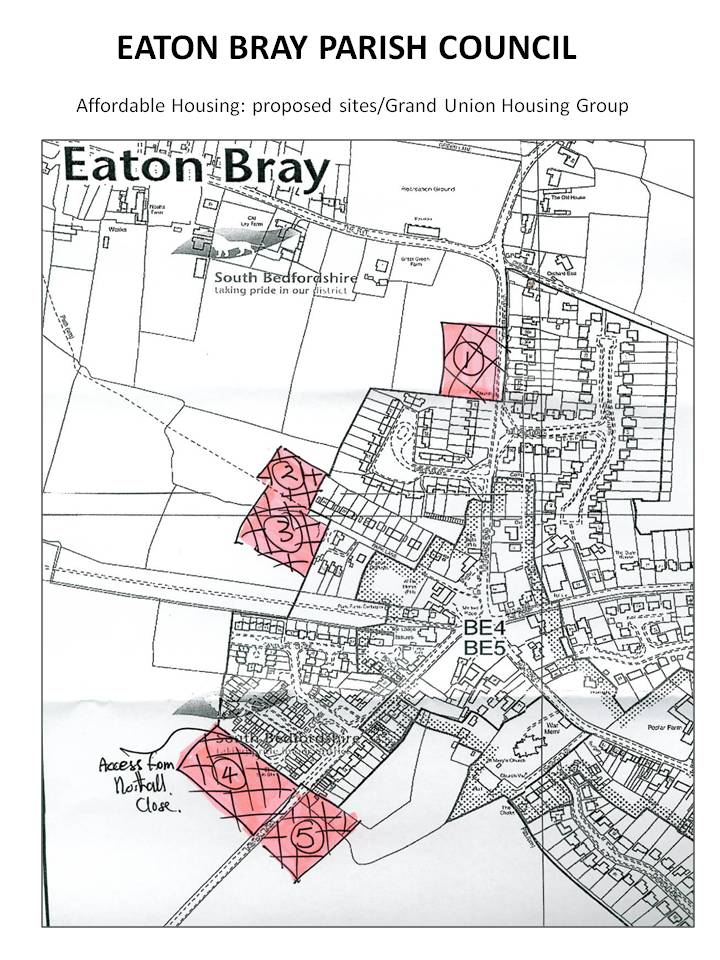
The council would like to gauge residents opinions on these sites, however it is important to note that the Parish Council is not endorsing these locations they are just recommended sites put forwarded by Grand Union and no decision as yet has been made.
Please email/write to the Parish Clerk (contact details on the Eaton Bray Parish Council website) with your comments by end October 2013.
Residents slam village housing plan
 A former parish councillor has slammed absentee landowners for trying to push through a massive housing plan for Eaton Bray which he says will blight the village.
Rick Brand has launched a campaign to try and halt potential moves to turn more than 20 acres of open space into housing.
The idea is in its infancy but residents fear that the chance to boost housing stock will lead to Central Beds Council looking favourably on the scheme.
It would mean the loss of former orchards and grazing land which stretch from Bower Lane/ Harling Road behind homes in Orchard Way, Moor End Lane and Mill End Close and down towards the Edlesborough border.
Mr Brand, a former EB parish councillor, moved to Mill End Close, because of the outlook over open fields which attracts a wealth of wildlife.
But he fears he may soon be looking at a new housing estate if the landowners get their way.
The site is owned by a former local woman now retired to Florida and farmers who live out of the village. Last year CBC asked landowners to notify them if they had any areas that may be suitable for housing development.
The Bower Lane site was offered as it is unsuitable as farmland. Moves were made in the 1980s to build on the land but the then South Beds Council threw out the idea because it was in Green Belt and would extend the village's natural boundary.
Now CBC must find room for more than 600 homes in rural areas and Eaton Bray has been identified as one area which could take some development.
Read more of this story on Leighton Buzzard Online and see tomorrow's Leighton Buzzard Observer for the full story.
For the latest news from Eaton Bray and beyond, get the Leighton Buzzard Observer every Tuesday and make a daily date with Leighton Buzzard Online.
Source: Leighton Buzzard Online
“I Can Remember When This Was All Fields”
Back in the heady days of the early noughties, before spiv bankers brought the economy to its knees and the housing market to a standstill, the Government decided that the nation needed to build more houses. Not just a few but hundreds of thousands. One of the places it chose to site these was southern Bedfordshire - and in 2005 Luton, Dunstable, Houghton Regis and Leighton - Linslade were formally designated as a “Growth Area”. Around these towns the green belt would be rolled back to make room for an additional 41,700. The job of deciding exactly where these houses should be built was given to a new “Joint Committee” made up of councillors from Luton, South Bedfordshire and Bedfordshire County Council's. The committee assembled a team of professional planners and work on the new plan commenced.
In June 2007 it was able to publish its first document for consultation - the “Core Strategy: Issues and Options” which explored various locations for the new houses. No less than 10 “options” were proposed, and, much to the surprise of many, some of the areas suggested for major new development were green belt villages outside the designated “growth area” - including Eaton Bray.
Soon afterwards the collapse of Northern Rock heralded the end of cheap and plentiful credit and the housing market collapsed. House building ground to a halt. But the joint committee's work continued - albeit slowly. By the time this article appears in Focus it will have published its “Core Strategy : Preferred Options” document for consultation. This refines the ten options to one. It sidesteps the issue of precisely where new housing will be built - delegating this to a later document called the “Site Allocations DPD” - but it does identify general areas for growth.
Most new development is to be located in or adjacent to the four towns, but the expansion of villages is also proposed. The key wording is in Policy CS1: “A limited scale of development will be allocated or supported in rural areas. This will be in and/or on the edge of the rural settlements that are currently excluded from the Green Belt...... Small scale reviews of the Green Belt boundary on the edge of these rural settlements may be required to enable such development to proceed...
Eaton Bray is such a “rural settlement” and the Policy opens up the prospect of pressure for the release of land on the edge of the village, currently in the Green Belt, for new housing development. What “limited” means is not made clear. Views will vary about whether this would be a good or a bad thing, but the matter deserves to be the subject of local scrutiny and debate. The future of your village depends on it. The opportunity exists now to have your say, one way or the other, so don't miss it!
-- George Crutcher. MRTPI
This is the second of an occasional series on of articles on Town Planning issues. George Crutcher is a locally based Planning Consultant.
Source: Focus, May 2009
Facing the housing challenge - action today, innovation for tomorrow
 A series of further measures and reforms designed to help alleviate the current challenges in the housing market and to support the vital delivery of more homes over the long-term, are being announced today by Housing Minister Caroline Flint.
The measures are part of a new update, published today, on progress to delivering more homes, helping first time buyers, supporting existing home owners, assisting the industry which is currently facing tougher conditions, and ensuring that the right foundations are in place for a recovery in new build starts.
Housing Minister Caroline Flint said:
"The package being announced today will both help people facing difficulties right now, and lay the foundations to help meet the long term housing needs of the country.
"That means being ambitious, but also practical and realistic, acknowledging not only the difficulties faced by individuals and families, but for those who work in the house building industry.
"We are determined to continue to do everything possible to promote long-term stability and fairness in the housing market. The international credit crunch has created significant challenges not just for the UK housing market, but in other parts of Europe and the United States.
"However, the long term need to provide more homes has not gone away. We have a growing and ageing population and will only see worsening affordability unless we increase housing supply."
The measures include:
- A new scheme to support first time buyers into affordable home ownership by renting first and buying later. Under the scheme, eligible households earning £60,000 a year or less will to able to rent a new home at a discounted rate for a period of two to three years. They will have the option to buy a part share in the home. The affordable rent, which will be 80 per cent of the market rent or less, will enable the household to save for a deposit to buy the share in the home. The new pilot scheme, called Rent to Home buy, is designed to give more choice and flexibility to first time buyers, and is part of the Government's low cost home ownership schemes
- New partnerships between the public and private sector that will put councils back at the centre stage of providing homes. The first 4 Local Housing Companies will be announced today, in Barking and Dagenham, Newcastle, Nottingham, and Manchester. Under this new partnership between councils and the private sector, councils put forward their surplus land into the Local Housing Company and have a full part in agreeing the development, which must include at least 50 per cent affordable homes. In return, private sector partners, provide the equivalent investment and homes and skills needed to build the homes.
- New proposals to deliver up to 75,000 homes in 20 more towns and cities, with £100 million into these areas for the schools, hospitals and other facilities needed to support homes, The councils in these areas of high demand, from Northumberland to Cornwall, have been selected as New Growth Points and have pledged to increase the number of homes in their local areas by up 20 per cent by 2016, delivering a total of up to 75,000 extra homes.
- Allocating the first tranche of a £510 million funding pot to reward councils who are working to bring land forward for development, helping to provide more homes and give the house building industry greater certainty that suitable land will be available when the market picks up. The Housing and Planning Delivery Grant is a direct incentive for councils who are taking action to meet the housing needs in their areas and rewards those putting plans and land allocations in place.
- Confirming that more funding, beyond the £200 million already allocated to buy unsold stock from house builders for affordable homes, could be made available, should the properties by in the right place, at the right price, and offering good standards. The Government believes this is the right approach rather than setting an arbitrary cap on the figure, to avoid the purchase of inappropriate properties. The Housing Corporation is now in discussion with many of the major house builders to discuss options for bringing unsold homes into the affordable housing sector.
- New plans to work with local authorities and housing associations to examine proposals for mortgage rescue schemes and the wider role they could play in supporting home owners. Some councils, for example, are assisting housing households through an emergency hardship fund, usually in the form of loans, as part of their homelessness prevention work.
- The National Housing Advisory Service will shortly publish a new advice leaflet for home owners, pulling together all the up-to-date contact details of major national money, debt and legal advice agencies into one consumer friendly document. The leaflet will be distributed in August by local authorities, CAB, Shelter, and money advisers.
Source: Government Office for the East of England
Don't wait, build your own
Families on the South Beds council housing waiting list were invited to make a saving of more than £11,000 by building their own homes.
South Beds District Council had sold a piece of land off Northall Close, Eaton Bray, to Rother Self-Build Consultants.
The company would provide backup throughout the DIY scheme to build 15 three-bedroom detached homes.
Applicants would pay £28,750 per home - but the actual value of each property was expected to be more than £40,000.
Source: Dunstable Gazette, 5 April 1984
Cantilupe Close self-build
Skilled craftsmen on the South Beds council housing waiting list have been invted to build their own homes, in a do-it-yourself scheme in Eaton Bray. The idea is that the homes can then be sold to them at cost price.
South Beds District Council, which is backing the project, has sold a piece of land off Northall Close to the self-build consultants behind the scheme.
The plan is for 14 three-bedroom detached homes to be built, starting in the summer.
Source: Dunstable Gazette, 26 January 1984